
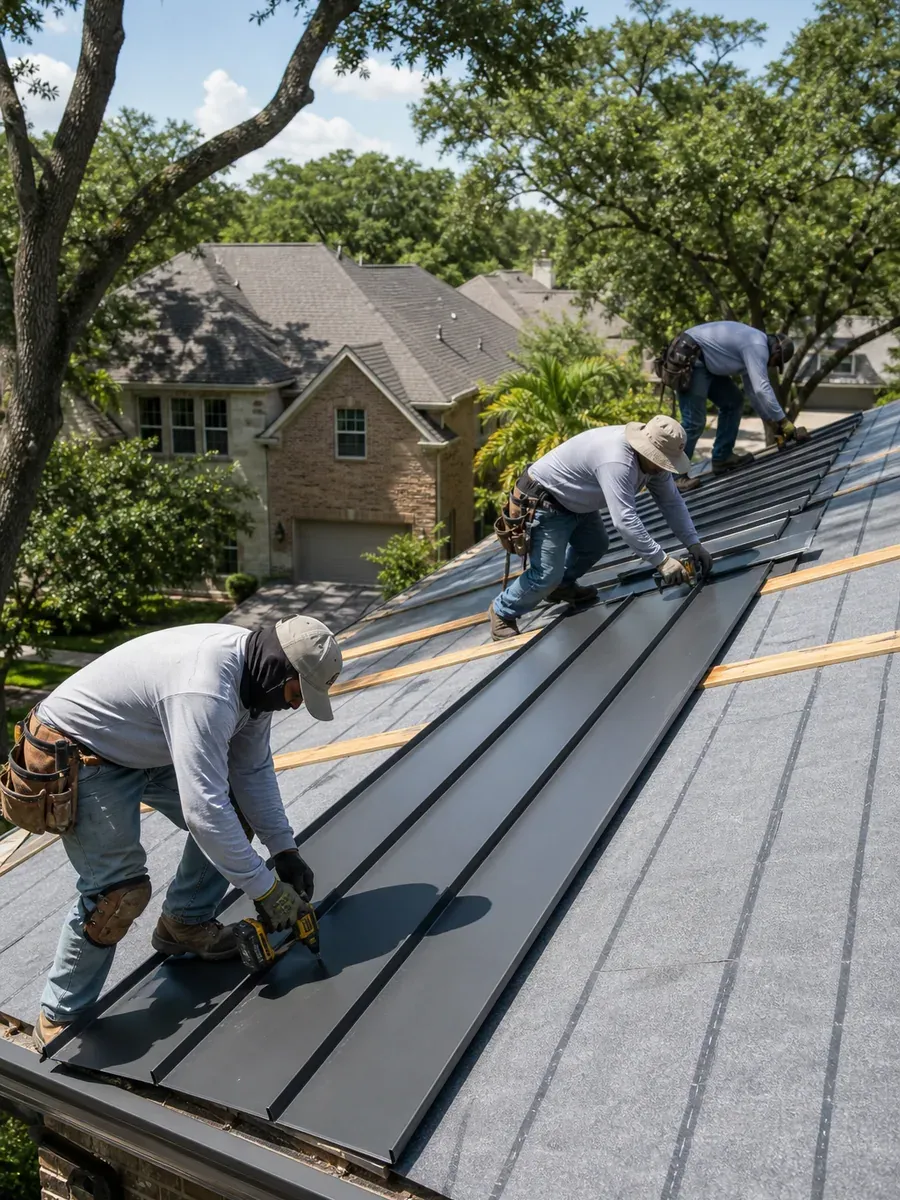
Is Metal Roofing Worth It for Your Houston Home?
Published May 30, 2026
Metal roofing has become one of the fastest-growing roof choices in Houston, and the Gulf Coast climate is exactly why. Standing-seam metal shrugs off hailstorms, stands up to hurricane-season winds, reflects the brutal Texas summer sun to cut cooling bills, and routinely lasts 40-70 years — two to three times the life of asphalt shingles.
What metal roofing costs in Houston
Standing-seam metal typically runs $8 to $14 per square foot installed in the Houston market, compared to $4.50 to $8 for architectural asphalt shingles. On an average-size home, that works out to roughly:
| Material | Typical installed cost (avg. home) |
|---|---|
| Architectural shingles | $7,500 – $17,000 |
| Standing-seam metal | $12,000 – $28,000 |
That’s a real premium — usually 60-80% more than shingles upfront. The payoff is a roof that outlasts two or three shingle replacements and needs far less maintenance along the way.
How metal performs in the Gulf Coast climate
- Wind resistance — standing-seam panels are mechanically fastened or clipped in a way that resists wind uplift far better than shingles, a meaningful advantage during hurricane season.
- Hail resistance — metal doesn’t lose granules or bruise the way asphalt does. Cosmetic denting can occur in severe hail, but the roof’s waterproofing integrity holds up.
- Heat reflection — reflective metal finishes lower attic temperatures and can noticeably reduce summer cooling costs compared to a standard dark shingle roof.
- Humidity resistance — metal doesn’t support the algae and moss growth that shows up as dark streaking on shingle roofs in humid climates.
Metal roof repair: what it actually involves
Damage to a metal roof doesn’t automatically mean a full replacement. Most metal roof problems are repairable on their own:
- Loose or backed-out fasteners are the most common issue on exposed-fastener metal roofs, especially after Houston’s heat cycles expand and contract the panels repeatedly. Re-fastening or swapping the fastener and washer usually solves it.
- Small punctures or dents from hail or wind-blown debris can typically be patched or have the affected panel section replaced without touching the rest of the roof.
- Failed sealant at seams, ridges, and penetrations (vents, chimneys, skylights) is routine maintenance, not a sign the roof has failed.
- Isolated corrosion, often where two dissimilar metals meet, can usually be addressed locally if it’s caught during a routine inspection.
Full replacement is typically only necessary when corrosion or fastener failure is widespread across the roof rather than limited to one area — uncommon on a well-installed system within its expected lifespan.
Is it right for your home?
Metal makes the most financial sense if you plan to stay in your home long-term, want to minimize storm-related repairs, or are trying to lower cooling costs. If you’re planning to sell in the next few years, the upfront cost may not pay back before you move.
Call for a free estimate and we’ll help you weigh metal against shingles for your specific home and budget — no pressure either way.